Planting and Care Guidelines
- Select a planting location with good drainage, where plants will receive at least 6 hours of sunlight.
- Morning sun is especially helpful in reducing common fungal diseases.
- For sun-loving roses, more sun equates to more flower production, which means at least 6 hours of sunlight.
- For gardens with more shade, select roses designated as "Shade Tolerant". This means less than 6 hours.
- Always choose rose cultivars with a hardiness rating for your zone. If you are unsure, please ask us.
- Soil should be fertile and loose with plenty of organic matter; however, limit the use of animal manures and avoid adding any fertilizers at planting time, especially those high in nitrogen.
NOTE: Nitrogen fertilizers at planting can cause root burning and severely limit future potential flower production. A phosphorus fertilizer like bone meal or rock/superphosphate can be used safely at planting when applied according to product label instructions.
Rose Spacing
Spacing is important for proper plant development and to help reduce potential disease infections.
General rose spacing guidelines:
Container Sizes
Container sizes should fit the potential root zone capacity.
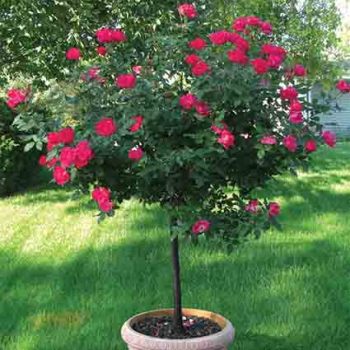
For Hybrid Tea, Grandiflora, Floribunda, Shrub Roses, Groundcover types, and Tree Roses a container 2 feet x 2 feet is best.
Smaller climbing roses can use this sized container too, but larger growing climbers will perform best with more root space in a larger pot.
Mini Roses will perform best in pots that are 12-15 inches high and wide.
NOTE: Any containers should have adequate drainage holes.
Know your rose!
Choose an appropriately sized rose for your space.
If a rose is described as being a vigorous grower, leave the maximum amount of space between plants.
- Roses should be planted at least 2 feet away from a solid surface like fences, walls, or structures to prevent damage from reflected heat and to maintain proper air circulation.
- Maintain proper distances from other competing plants as well.
- Remove all competitive weeds and turf grasses from rose planting beds.
Planting Depth
- In zones 6-10 the graft or crown of the rose should be 1-2 inches above natural soil grade.
- In zones 3-5 for grafted roses, the graft should be 1-2 inches below natural soil grade for extra winter protection. Own root roses can be planted with crowns even with the soil grade.
Planting Bareroot Roses
- Soak the roots in clean water for 12 to 24 hours before planting.
- Examine the plant and prune off any broken or damaged roots or canes.
NOTE: DO NOT root prune unnecessarily.
- Dig a hole large and deep enough to properly accommodate the roots.
NOTE: Roots should not be bent or twisted at planting.
- Blend 50/50 leaf compost or peat moss with natural existing soil.
NOTE: Do Not use potting soil for amendment, it is too dense, holds too much moisture, and causes root rot issues.
- Mound blended soil into a cone in the center of the hole and spread roots gently over that soil cone.
Carefully add soil around the roots.
Tamp down gently until the hole is 2/3 full, then add 1-2 gallons of water to eliminate air pockets and moisten thoroughly. After the water has soaked in, fill the remainder of the hole with more soil blend as needed and water slowly with another 1-2 gallons of water.
Using sterilized, clean pruners cut each cane back by 1/2, leaving canes with 3-5 eye-buds. Any canes that are less than pencil thickness should be removed entirely, back to where they emanate from.
IMPORTANT: Once planted & tip pruned (See above), then mound over the crown & canes with loose mulch, compost or your soil blend. This step protects the canes from drying out or from potential freezing in cold zones until root & shoot growth begins, which typically takes 2-4 weeks, but can take longer depending on conditions.
• Be patient. All roses are different. Some varieties will leaf out sooner than others. This is normal.
• As new growth appears, carefully wash the soil covering off the canes, taking care not to break off fragile new shoots.
• Maintain consistent supplemental water using the 1 inch of water per week, per plant.
• Apply water, slowly and deeply, allowing it to soak in well to a 6-8 inches depth root zone.
• Add a 2-to-4-inch layer of mulch around each rose to help conserve moisture and help with weed suppression.
Roses: Proper Pruning priorities
• To remove dead, damaged or diseased wood
• To increase air circulation through and around the rose
• For general shaping of the plant
• To encourage proper growth
• To increase flowering wood
Most rose pruning should be performed in the spring, while plants are still dormant.
For all roses, make cuts at approx. 45-degree angles, about ¼ inch above an outward facing bud.
Pruning guidelines by classification
Hybrid tea, grandiflora, floribunda, and miniature roses
• All these rose types produce the best blooms on current season wood.
• Prune all canes back by half to 2/3 depending on the age of the plant.
o First, remove broken, damaged or diseased canes
o Next, remove all small or thin canes or crossing canes.
When finished, the rose should have 3-5 stout, healthy canes remaining that are evenly spaced, at the proper height, with 3-5 outward facing buds on each cane.
Shrub roses
• No severe pruning is recommended.
o Let new plants grow for 2-3 years with little to no pruning.
o For mature plants, prune off dead, wither damaged top canes to approx. ½ height.
o Thin out 1/3 of the oldest canes leaving 2/3 to produce blooms for this season
Climbers
• Let new climbers grow for 2-3 years with little to no pruning
• Remove winter damaged or diseased wood.
• On mature plants, prune laterals and shoots back by 3-6 inches to encourage blooming.
• Every few years, remove the oldest canes to the ground, which renews the plant and encourages new vigorous bud shoots.
Ramblers
• Prune once per season, immediately after they flower. (Most bloom on 2-yr-old wood)
• Always remove dead, damaged or diseased canes.
Sanitation, sanitation, sanitation
• All pruning tool tools should be cleaned and sanitized prior to making pruning cuts and after all pruning on one plant is complete, before moving to the next plant.
• Sanitize tools with 10% bleach & water, sanitizing wipes or rubbing alcohol.
• When pruning canes with visible lesions (black or brown tissue) cut 1-2 in. below visible infection location, into healthy green tissue. Then sanitize pruners again before making additional cuts.
• Fungi that cause canker or botrytis blight are easily transmitted and spread accidentally by dirty pruners
Winter Protection
Most roses need winter protection in cold climates, especially for budded roses and winterization starts earlier in the season than most gardeners realize. With weather extremes happening more frequently, rose growers in any region may find it beneficial to practice many of the following winterization rules.
• Stop fertilizing roses by mid-July in most climates.
o In warmer zones fertilization should stop by the beginning of Sept.
• No pruning should be done past Labor Day. Even dead heading can stimulate growth that prevents dormancy.
o Later, after a few consecutive hard freezes (29°F or lower) and after the rose goes dormant, then you can prune without issue. Otherwise, be safe and wait until late winter to early spring for hard pruning.
• In late fall after the first killing frost, mound 6 to 8 inches of soil over the crown of the rose.
• After that soil mound is frozen, then cover the tops with clean straw, marsh hay or pine needles.
• In warmer zones, make sure 2-3 inches of fresh mulch top-dressing is added.
• And for all zones, if fall weather is dry, make sure to water your roses. Damage during winter from desiccation is a major risk and can be as harmful as freezing itself.
Note: Rose cones are an alternative for winter protection in cold climates but should be deployed only after 2-3 hard frosts and after the ground is frozen to a depth of 2 inches. Make sure the top of the cone has adequate air holes.